Stress and the Secret Treat

Photo by Nathan Dumlao on Unsplash

Yesterday I had to stop myself from hiding a package of cookies in the basement so that my husband wouldn’t know I was breaking my self-imposed “no more sweets” rule. An image of me standing alone in the laundry room, munching on cookies, seemed pathetic. So, I put them on the shelf in the kitchen and offered to share them with my husband in the hope that they would be gone soon.

This is what it has come to in this glorious first month of 2024—writing about sneaking food.

When I first started this blog, the theme was summoning the courage to try new things, take big leaps, and stretch myself in different directions. In the seven-plus years since my initial post, I’ve tried many new things and taken several huge leaps—including writing and self-publishing my first book and quitting drinking. Major accomplishments!

At the same time, I’ve gravitated toward writing about smaller, everyday adjustments in my life. I’ve been exploring how to make intentional choices with my time and energy, and how to honor my personal needs, temperament, and capacities.

Many of my blog posts address my ongoing effort to spend more time doing things that strengthen me in the long-term and less time doing things that deplete me. The problem is…some of the counter-productive behaviors I’m drawn to actually feel pretty good in the short-term. Can you relate?

We’ve been going through a tough time in my household lately. My mom, who is 84 years old and lives with me and my husband, has a number of health issues. She has been hospitalized three times in three months, and now she’s in a rehabilitation facility. It’s been challenging.

In the quiet moments when I’m not talking with one of her doctors or a nurse or a case manager, when I’m driving home from visiting her, I feel overwhelmed.

More than once I’ve thought to myself:

I’m trapped.

I’m drowning.

How much more can I take?

What about my own health?

I’d like my life back, please.

(Yes, I’m a bit melodramatic.)

Enter, the reward. As someone who decided six years ago to stop rewarding myself with alcohol because it no longer served me, I’ve become acutely aware of the many other treats that I use to temporarily boost my mood. My recent go-to rewards include:

  • A pack of Reese’s peanut butter cups, grabbed while checking out at the grocery store and quickly consumed in my car
  • Purchases I don’t need: more 50%-off holiday wrapping paper, another kitchen gadget, or a second pair of nine-dollar pajama bottoms
  • A quick (and then not so quick) scroll on social media, despite my commitment to take a break for a couple months

Though I am well aware that these rewards are like tiny bandages on a gaping wound, I find it hard to deny them to myself. Why can’t I give myself sweets, cheap stuff, and cat videos if I want? Don’t I deserve them?

However, the positive effect of these treats dissipates quickly. Much like drinking, they need to be repeated over and over, and the cumulative effects are not so positive.

Also, when I’m feeling majorly stressed out, I’m less inclined to do things that are more challenging but worth the effort, such as going to yoga and dance class, hiking, meditating, reading novels, and working on my second book.

The less I participate in these activities, the harder it is to get back into them. About a month ago I was in a serious funk, and I finally forced myself to get outside in the sun and take a walk. Within five minutes, I could feel my mood lift. The same thing happened when I returned to dance class after a months-long knee injury. I had forgotten how much I enjoy dancing and watching all the other people in the class dance. Their joyful energy is contagious and life affirming.

High on my Really-Need-To-Do list are: attending caregiver support group meetings whenever I can, connecting with friends, and asking for help even when it feels uncomfortable. I had to scale way back from my part-time job (which I truly enjoy)—I didn’t want to do this, but as I accepted more responsibility for helping my mom, I had to release some responsibility elsewhere. I know I can’t do it all.

My promise to myself for this new year is to balance living in the moment with taking care of myself in ways that I know will leave lasting, positive results. But I can’t say I won’t grab the occasional cookie for my trouble. Or one more pair of pajama pants.

My Latest Social Media Reset

A few days into my current social media cutback, a notification flashed on my phone announcing that my screen time was down by 16 percent. I’m hoping next week will show an even further decline, as I continue to curb my mindless scrolling.

I’ve written about my complicated relationship with social media before, and this probably won’t be the last time. Here are a few ways that my social media consumption is getting under my skin lately:

  • For me, social media provides ongoing evidence that “comparison is the thief of joy” (a quote attributed to Teddy Roosevelt.) As I scroll through Facebook and other platforms, I feel as if I’m not doing enough in my life and I’m not posting enough online. How do these folks do so much every day and have the time to write about it? I must be doing something wrong, or maybe I’m just plain lazy.
  • On Instagram, I can’t help but watch many of the “suggested reels” the platform serves up. Somehow, Instagram knows that I am a sucker for watching videos of supermodels walking in fashion shows, before/after shots of women with and without makeup, and celebrity cosmetic surgery transformations. (I can’t believe I am telling you this.) Why am I mesmerized by this stuff?
  • I’ve started feeling more than a bit disturbed about the path we are headed down, where more and more of our lives’ moments are photographed and posted online. I’m guilty of this, too, and I worry about the long-term effects of living with this camera and potential audience in our mind. How will this behavior affect us long-term as individuals and our society as a whole? (I may have to do a whole other post about how when I searched for an image to go with this piece, only women were shown taking selfies.)
  • As a self-published author with a book to promote, I fear that I’m not using my social media accounts in the most effective way. I stopped posting on TikTok because I kept hearing that authors need to post three or more times a day, and there’s no way I’m going to make that happen. But then I’m also concerned that the time I spend on social media is distracting me from finishing my second book. Is there any way to get this balance right?

I still believe there is much to be gained from interacting with social media. It allows me to stay in contact with people from my past and even my present who I rarely (if ever) see in person. Over the past year and a half, I’ve used social media to learn how to self-publish my memoir, and in the process, I’ve met other authors from around the world. I’ve even done podcast interviews with shows produced in the UK and South Africa.

When utilized as a tool, social media works for me. But when used as a form of endless entertainment or as a way to avoid doing the next thing on my To-Do list, it leaves me feeling empty and anxious. It is a ruthless time killer and soul suck.

So here I am, yet again, taking some time off from social media. For the month of December, I’m trying to significantly reduce the number of times I pick up my phone just to see what folks are posting. I may visit specific accounts in an intentional way to gain information, but the scroll, scroll, scroll is on the back burner. I’ve found that I like posting in my stories every day, but I’m going to experiment with sharing mostly original content instead of posts I’ve found through scrolling.

Then, in January and February, I’m going to buckle down and finish my second book. During that period, I’ll limit my social media time to posting updates about this forthcoming book and whatever else feels critical.

Every time I do one of these cleanses or reboots or whatever you want to call them, the benefits are undeniable. I always say that, who knows, maybe one day I will just leave social media altogether. It hasn’t happened yet, and as an author who hopes to build a dedicated readership, it’s hard to walk away. But the least I can do is develop a more thoughtful approach to how I spend my time on screens—especially that little one that fits all too easily in my hand.

Leave it.

Photo by Jon Koop on Unsplash

About a month ago, I was walking my dog one morning when another dog-walker approached from the opposite direction. She stopped and held her dog’s leash taut.

Then she said firmly, “Leeeave it.”

I had heard people say this before to their presumably excitable dogs, urging them to ignore distractions, particularly of the canine kind. But for some reason it made an impression this time.

What a great motto for humans: “Leave it.”

I have a hard time leaving all kinds of things alone. Here are just a few of the many:

  • An unreturned text from a friend
  • My mother acting in a way that doesn’t make any sense to me
  • A disagreement with my spouse
  • A silly mistake I made at work
  • A car honking behind me at a traffic light
  • A decision I’m second and third guessing
  • That project I know I should be working on

I fret and fuss about these things, letting them take up way too much real estate in my brain.

You might have heard about “sitting with your feelings”—especially if you listen to guided meditations or are part of the recovery community. Sitting with your feelings, observing them, and letting them calmly pass, is a good thing. I’m not trying to avoid that step, I promise.

What I am trying to resist is being sucked up into a tornado of emotions. For decades I let my anger, fear, embarrassment, self-pity, frustration, and sadness consume me. The feelings would grow more intense as I fed them the fuel of my indignation and paranoia. It became difficult to extricate myself from one of these storms. I would grow more upset as the issue took on epic proportions.

Meditation has helped, as has journaling—though the effects of these are more cumulative than immediate. In the moment, deep breaths can do wonders. Reminding myself of the pointlessness of getting all worked up can also be helpful.

Not long after the “leave it” encounter, I was working a booth at an event where I was selling my book. I had a large mirror standing on an easel, mimicking the bathroom mirror where one might leave themselves an inspirational message. On the table, I had provided lots of brightly colored Post-it notes and a bunch of Sharpies for people to write affirmations and stick them to the mirror. They could also take one if there was a message that spoke to them.

Most of the messages were short, such as:

“I am cared for”

“You are enough!”

“I am healing”

A woman stopped by my table and informed me that she had a message to share, but it was kind of long. I encouraged her to write it out, telling her that it might be just the message another person needed to see that day. She wrote:

“Not everything or everyone deserves your energy. Do not respond. Do not reply. Do not be provoked or provoke. Protect your peace.”

There it was. I was not alone in my struggle.

No more than half an hour later, a different person was looking at the mirror, and I heard them exclaim, “Yes!”

After contributing their own affirmation and chatting with me a bit, I saw that they had taken the “protect your peace” message. This beautiful soul friended me on social media, and I was delighted to see them share that Post-it with the world (plus a dazzling selfie they took in my mirror, surrounded by all those colorful, positive messages.)

We are all so much more alike than we realize. We all wrestle with negative emotions that want to grab tight and pull us down into the vortex.

The next time this happens to you, try telling yourself to “leave it.”

Hey, if you haven’t grabbed a copy of my book yet, please take a minute to check it out!

The Gift of Five Alcohol-Free Years

Today I am celebrating five years of sobriety. Six years ago, if you had told me I would one day use the words “sobriety” and “celebrating” in the same sentence, I’d have laughed out loud.

But a quiet part deep inside me would have been elated to learn that change was possible. Part of me had been hoping I would eventually find the courage, strength, and determination to give alcohol the boot.

Drinking was a big part of my life from the age of sixteen. I couldn’t imagine going out to dinner, starting the weekend, or marking an important occasion without an adult beverage. Feeling happy? Have a drink (or two). Feeling sad? Have a drink (or two). Stressed out? Have a drink (or two). Kinda bored? Have a drink (or two). And once I had a couple glasses of wine in me, it was likely that many more would follow. I didn’t do this every night. But I did do it often enough. Consistently. For decades.

When I finally decided to quit, it wasn’t a life or death matter. But it was a quality of life issue. For what seemed like ages, I had been running the cost-benefit analysis of drinking in my head, and the trend was not headed in a good direction.

I wanted to write. I wanted to be more active. I wanted to try new and interesting things. But I was most certainly not doing any of this.

So, on May 12, 2017, I decided I had had enough. It was time to give sobriety a try.

At first, I concentrated on resisting the cravings, and I gritted my teeth when everyone else was getting buzzed and I was consumed with FOMO. I paid attention to my triggers and slowly dismantled them one by one. (A completely unexpected trigger still pops up from time to time!)

As the years went on, the journey became less and less about drinking. Removing alcohol from my life was like discovering a door to a whole new wing of my psyche. I uncovered other coping mechanisms that I was using to soften the edges or distract me in the short term—fixations such as TV, social media, and shopping that did not produce positive results in the long term.

Sobriety ended up being about so much more than declining to put a substance in my body. It was and is about emotional growth, building skills that last, and developing hard-earned confidence. At last, I was able to focus more productively on my anxiety, fear of death, and obsessive-compulsive tendencies. All the stuff I thought alcohol was offering me—I had to learn how to give those things to myself.

And I kept the promise I made to myself: I committed to my writing. I ended up writing and self-publishing a book about my experience, in which I explored the patterns and stories that had kept me idling in place for so long. I tried all kinds of new things, including meditation, Pilates, aerial yoga, spin class, zip-lining, flotation therapy, paddle boarding, pole dancing, indoor rock climbing, and much more. I still do several of these activities regularly.

Not everything I tried to do was a success. The drum lessons I took at the beginning of my sobriety came to a quick end. My husband and I pursued two small business ideas—I even attended a six-month course related to one of these ideas—neither of which panned out. I started to build an online course in habit-shifting that I thought had real potential, but it was too much to take on at the same time as writing and editing my book. I did end up sharing it on this blog—and who knows, maybe one day I will get back to it.

The gift (there’s another word I didn’t think I would ever use in this context!), the gift of sobriety has been the ongoing process of unearthing who I am. “Coming into your own” is a phrase I never fully appreciated. But now I can tell you that it feels like bursting forth from a long dormancy, like opening up and reaching toward the sky.

What Sobriety Means to a Former Gray Area Drinker

A version of this piece was first published on the Genius Recovery website in October 2018. I am reposting it here in anticipation of my forthcoming memoir, which will address this issue at length.

When I decided to stop drinking in May of 2017, I knew I would eventually write publicly about my journey. Even before I made the choice, I started jotting down my thoughts about alcohol—the hold it had on my life, the challenges of drinking moderately, and the reasons why quitting was starting to look like the obvious solution.

Three months into my recovery, I revealed to Facebook friends and my blog’s tiny audience that I had managed to stay sober for the longest period yet in my adult life. I posted again at the five-month mark, at which point a few people suggested that it was time for me to congratulate myself and move on.

I don’t think so.

I’m rarely shy when it comes to sharing stories about my life. Nearly two decades of working in communications for a political organization helped me develop a pretty thick skin. I learned that no matter what a person says or how they say it, someone is going to find something in their words to criticize. But that shouldn’t keep us from speaking our truth.

My concern about writing on this topic stems not from a fear of being judged but from a suspicion that I don’t belong in the recovery community. You see, I’m what’s called a “gray area” or “high bottom” drinker. While I believe that I had an alcohol dependency, my habit never escalated to the level typically associated with people who quit drinking.

I was doing well at work, and my personal relationships were intact, but my dreams were stalled. Drinking had made my life repetitive and stagnant. My writing career and love of trying new things had been put on hold. This went on for decades.

Like many gray area drinkers, I tried all the tricks designed to keep alcohol at arm’s length but still within grasp. I counted drinks, tracked how many nights in a row I stayed dry, diluted my wine with seltzer, only drank when I was home or only drank when I was out, and so on. Nothing worked. My mind was more preoccupied than ever with thoughts of alcohol.

When I finally quit, I did so with the knowledge that I didn’t have to hit a disastrous rock bottom to recognize the negative impact alcohol was having on me. As a writer, I am eager to share this news with the world. As a longtime activist, I want to help others make the same realization as soon as possible.

But I worry that by talking about my sobriety, I am claiming ground that belongs to those who have struggled more. The insecure, anxious woman who turned to alcohol for confidence and comfort is panicked at the thought of stepping on anyone’s toes.

Feeling like an outsider was a monster that haunted me throughout my childhood, adolescence, and into my adult years. The beast is clutching at my ankles again, even when I’m feeling my sharpest and bravest.

The only way I know to get past this fear is to march directly through it. So, I am sharing with you what recovery means to a gray area drinker like me.

Liberation

My drinking habit was like carrying a backpack full of bricks at all times. I could function, but something was always weighing me down. I often felt tired, cranky and frustrated with myself. Hangovers stole hours from me on weekend days when I should have been having fun or getting errands done. And when it had been a couple days since my last drink, I was consumed with thinking about my next one.

Taking off that backpack allowed me to wake up every morning with zero worries about what I’d said or done the night before. By the end of my drinking “career,” I wasn’t going out and doing crazy stuff anymore, but I was still capable of picking fights with my husband, drunk dialing friends and posting nonsense on social media.

Being clearheaded and liberated from the effects of alcohol is truly a gift.

Perspective

When I was deciding whether to quit entirely or continue trying to moderate my drinking, I worked hard to put aside my emotional attachment to alcohol and appeal to my logical side.

Despite overwhelming evidence that I felt better when I wasn’t drinking, I kept at it. What if I did the same thing at work, employing an ineffective strategy over and over? My boss would have taken me aside long ago and demanded that I try a new tactic.

So, as my own boss, I gave myself a “needs improvement” performance review and chose sobriety as the answer. The results were so successful that I am applying this lens to other aspects of my life. This means examining other deep-rooted practices and asking if they are serving me.

In the quest to live my best life, perspective is everything. Sobriety changed my vantage point.

Self-Respect

How many hours, how many nights did I spend drinking? Some of those events included laughing and bonding with dear friends, but many of them were more about getting drunk than anything else. What if I had spent even half of that time writing and taking on new challenges?

Alcohol allowed me to do things that would have been boring or foolish if sober. Some were minor infractions, like waiting at the bar for a table, getting buzzed and skipping dinner to get trashed. Some were more consequential, like barely making it to an early morning doctor’s appointment and then sleeping off a hangover in the back seat of my car.

Now that I’ve removed alcohol from the equation of my life, I find that I value my time far more. And what do we have if we don’t have time? In recovery, I’ve concluded that valuing your time is the highest form of self-respect.

Peace

Since girlhood, my brain has been full of obsessive thoughts—fear of death, fear of embarrassing myself, fear of being seen as unworthy of attention or respect. My first therapist put me on Zoloft to help me focus in our sessions. But alcohol was my favorite form of self-medication.

Drinking to slow down my mind was effective but not without serious side effects. Even worse, it was getting me nowhere. I was not learning how to deal with my stress or my penchant for latching onto a sense of dread and letting it flood my body and spirit.

Sobriety didn’t automatically bring peace to my mind. I had to take up meditation and yoga. I had to remember to pay attention to my breath in moments of distress. Taking away alcohol made space for these more productive solutions.

The transformation I am experiencing is slower and less noticeable than guzzling two or three glasses of wine. But one day it occurred to me that I hadn’t experienced that panicky feeling in weeks. I still get lost in worry and self-doubt on occasion, but I have the tools now to acknowledge those thoughts and then carry on.

Sharing these breakthroughs is why I am proud to take my place in the sobriety community.

Quieting the Tyrant Within

A version of this piece was first published on the Genius Recovery website in December 2018. I am posting an updated version here because it addresses a topic that will always be relevant to my emotional growth.

Over the past five years, I’ve come to see my life as an ongoing project. I launched this blog, ditched my corporate marketing job, quit drinking, started moving my body more, spent a summer trying new things from my bucket list, and started writing a book.

Then, I decided to take on a different kind of challenge. Digging deep, I realized that what I could really use is more compassion for and acceptance of others. But how does one go about getting that? And why is it so hard to resist criticizing people, especially those closest to us? As I began exploring my motives, a surprising inspiration surfaced: an unforgettable biopic.

Back in the 1980s, the Jessica Lange movie Frances made a profound and lasting impact on me. Recently I watched it again, and three decades later it still has the power to reach in and prod at one of my tender spots.

Frances Farmer was an actress who rose to fame in the 1930s. The film depicts her as an independent thinker who doesn’t care much for authority or convention. Farmer appeared in a number of movies, but she chafed against the Hollywood studio system, eventually running into trouble with the law and spending time in multiple psychiatric hospitals.

There is little doubt that Farmer suffered from mental health and substance use issues, but the intervening actions taken by her family and medical professionals come across as severe and designed to break her nonconformist spirit.

In two different scenes in the movie, Frances is dragged into police custody kicking and screaming. Her eyes and hair are wild, her anger and fear palpable. I was only about 20 years old when I first saw the movie, and Farmer’s desperation and utter abandon in those scenes terrified me. I was afraid that one day I might lose control like that, but at the same time, I was afraid that I wouldn’t.

Image of Jessica Lange from the movie Frances.

*****

When a child puts their hand on a hot stove, they learn quickly not to do it again. That was me. Always the observant and obedient child. I was raised to be a good girl, to be nice and agreeable, and to follow the rules. Hell awaited me if I sinned, and on Earth there was shame to keep me in line. I wouldn’t have had the guts to write an essay like the one Farmer penned in high school, entitled “God Dies” — though I shared her early skepticism of religion and an all-powerful god.

At the age of 16, I finally broke loose, rebelling in the ways of many teenagers. I played stupid pranks with my friends and shoplifted. I got drunk and messed around with lots of boys.

Yet something was always holding me back. An alert system had been planted inside my psyche that kept me a safe distance from the edge. I learned to be my own mini-parent, with internalized restrictions and punishments.

I flirted with eating disorders, alcohol abuse, drugs, promiscuity, and self-harm. Still, I never fell down the rabbit hole into any of them. I came the closest with drinking, but I did not hit what could be considered a typical rock bottom. When I finally quit, there was no big crash and burn. Just my sensible innate guardian kicking in and telling me to get sober.

*****

Depression, anxiety, and obsessive-compulsive behaviors have whispered to me throughout my life. Weird, morbid impulses hum softly inside me. Sometimes I think about shouting something horribly offensive in a public place. At random times, I envision how awful it would be to get stabbed in my eyes or my throat in some freak accident. This leads me to wonder if I would ever stab myself intentionally. Of course, I wouldn’t — I’m confident of that.

When I hear a suspicious sound in the middle of the night, I panic that someone could be breaking into the house to kill us. Maybe I want a crazed killer to burst into my bedroom, so I would be justified in screaming out in terror and fighting for my survival.

Years ago, I wrote a short story called “Wednesdays” about a woman in an abusive marriage. Every Wednesday she would risk her husband’s wrath by taking his classic car out for a drive by herself while he was at work. At the end, she takes the car out one last time and intentionally wrecks it, walking away to start a new life.

I find it telling that I put my own character through violence, humiliation, and potential self injury in order to give her permission to choose herself.

*****

We’ve all encountered people who can hold their hand on a version of that hot stove for what seems like forever. You wonder how they do it, why they do it.

When I see a friend or family member headed down a hazardous path, I can be, as someone once accused me, “judgmental, pious, hypocritical.”

In preparation for cultivating my compassionate side, I began analyzing why I’m so judgy. I was drawn to Holly Glenn Whitaker’s piece for SELF, “Ask a Sober Person: Why Do I Judge People Who Still Drink?” In it she talks about the Jungian theory of a “shadow” self — all those unpleasant traits that we have trouble facing in ourselves but can see clearly in others.

The notion that I’ve been judging a reflection of my shadow resonates with me. But I suspected that there was even more to it. That’s when I recalled Frances, and it occurred to me that I might be envious of these people as well.

I sat down and wrote out a list of how I could possibly be jealous of people experiencing serious mental health issues like depression or addiction. First, I listed my foolish belief that these disorders are a badge of honor and a sign of depth. I’ve always wanted to be perceived as effortlessly “cool” (whatever that is), and I don’t like being reminded that I lean in the direction of being ordinary. Basic. Vanilla.

Next, I considered that perhaps I’ve been longing to send out a cry for help by surrendering to my bleakest impulses. That one had a slight ring of truth to it, but it still didn’t sound quite right.

When I got to the third reason, I exposed fertile ground: The concept of “letting go” sounds enticing to me — a welcome relief from both the societal expectations of adult life and the self-imposed pressures that keep me in check.

The mini-parent inside me can be more like a tyrant than a kind caretaker. This dictator berates me to pay the bills on time, weigh myself every morning, replay conversations over and over, and do just one more thing, one more thing, one more thing before I can relax.

My desire to be in control at all times makes life so stressful that a downward spiral starts to look like a vacation. The problem is, mental health issues are not voluntary — we don’t buy a ticket and schedule time off for a breakdown. Even if we could, being depressed or in the grip of addiction is not a holiday from responsibility. It is brutal and confining.

If I want to be less judgmental and more compassionate toward others, I need to start with the one person I can best influence — me. I must give myself a break so that the idea of being institutionalized like Frances Farmer doesn’t seem so absurdly appealing.

And as I practice quieting my internal tyrant, hopefully I’ll grow increasingly grateful that I’m so darn stable.

My 2021 Year in Review, Part II

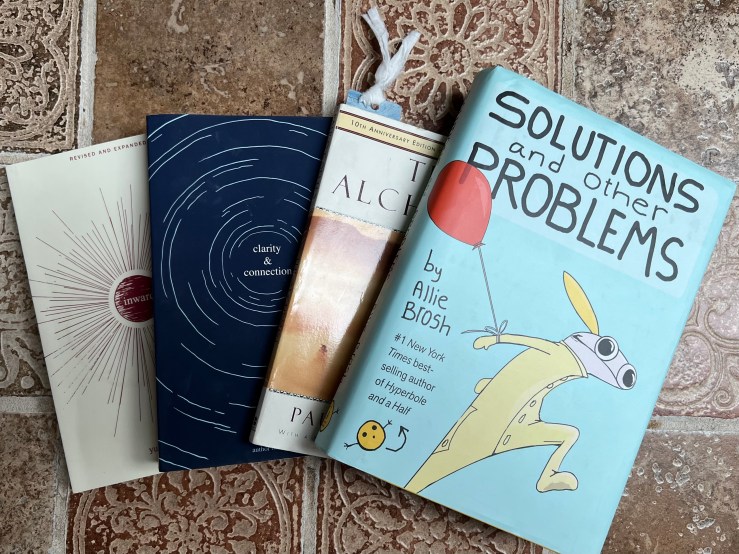
Just a few of the books I read in 2021: inward and clarity & connection by yung pueblo, The Alchemist by Paulo Coelho, and Solutions and Other Problems by Allie Brosh

When I launched this blog in 2016, I did so to “document my attempt to stretch myself and experience all the interesting bends and branches in life that are calling to me.” Five years later, I’ve pretty much kept to that original mission.

At the close of 2021, I am starting a new practice of giving myself a pat on the back for the stretching I’ve done over the past 12 months. This is the second part of my year in review. If you missed the first part, feel free to check it out first.

Reading

From childhood through my 20s, I was a voracious reader. But somewhere along the way my reading trickled down to a handful of books a year. I’m a slow reader because I like to reread lines several times and turn the ideas over in my head. For the last decade, I focused on reading political/social commentary, which can be exhausting, so I was taking long breaks between books. In 2020, I read a mere six and a half books.

So, I set a goal to read more books in 2021—no precise number, just to keep reading. I alternated fiction with non-fiction, which proved to be super helpful. Now, I’m ending the year having read 28 books!

I read books from genres outside of my comfort zone, works set in other countries and cultures, and books that addressed race, sexuality, and the natural world. Several books were challenging, but I persisted. And I did give myself permission to set aside two books to finish another time (maybe).

One of the books I’m counting toward my tally was the journal/workbook What’s Your Story? by Rebecca Walker and Lily Diamond. This book challenged me to write rather than read, though it also included some beautiful writing at the opening of each section. Instead of marking up the book, I typed up my responses in a Word doc, and when I looked back, I discovered that I wrote more than 40,000 words!

I created a fun graphic summarizing my reading for the year, and I’m going to post it on my Instagram profile. My profile is @lisamaybennett if you want to check it out.

I’m tempted to try to read even more books in 2022, but I’m not going to pressure myself—I’m just going to keep reading, book after book.

Connection

Looking back at the people with whom I’ve been in contact over 2021, I am immensely grateful to have so many wonderful folks in my life.

This was the year that I reached out to a wide range of friends and acquaintances to ask if they would test read my manuscript. I was delighted by the number of people who said yes, and we went on to have many interesting exchanges. I became good friends with a woman down the street through this process, and I connected online with an independent author who lives in the same town where I grew up.

My husband and I have gotten to know our next-door neighbors better this year, as well as other families who live on the block. I should probably credit our dog, Toby, with helping us make new friends—he is a great ambassador!

I am still in contact with two of the women I met through a Zoom grief group that I joined more than a year ago. My friend who passed away nearly two years ago had a pretty big family, and I have been in touch with two of her nieces and her sister-in-law, which has been a great comfort to me. And I continue to text and talk regularly with my closest friends.

Once we were all vaccinated, we had quite a few visitors out to the house this summer. I guess I’m what you might call an extroverted introvert (or an introverted extrovert?). I love spending time with people and talking with them, but I also value my quiet, alone time. Sometimes it’s hard to find the right balance, so I may have overdone it in 2021. But I can’t say that I would change a thing.

Media and Tech Use

This is the one category where I tried to do less in 2021 rather than more. Since I was a kid, I’ve loved watching television, reading magazines, and following celebrity culture. I was the perfect target audience for the internet and social media.

Over the past five years, I’ve been working on spending less time watching TV and scrolling on my phone. This year, my TV consumption finally settled in at a level with which I’m comfortable. I no longer watch TV during the morning, day, or early evening, and I only sit down to watch it when I know what show or movie I’m going to watch. My cable news viewing has declined dramatically, and I feel less tense as a result.

I still struggled with social media use in 2021. I no longer argue with folks in the comments, and on the rare occasion when I do, I am quickly reminded why I steer clear of doing so. But social media always seems to find a new way to grab me. I have never watched a single episode of any Kardashian show, and yet I find myself watching videos of Kylie and Kendall Jenner on Instagram as well as the dancing and fashion videos that are served up to me through ads and the search function.

In the first part of this review, I promised myself I would focus on how far I’ve come, not on how far I still have to go. So, I’m not going to go over the steps I want to take in 2022—I’ll write more about this next year. Instead, I will state for the record that I shifted substantial blocks of my time this year from media consumption to creative endeavors and other habits that I wanted to develop.  

Rest

For decades I have suffered from various forms of insomnia. Over the past five years, my sleep has vastly improved, but it still feels like the final frontier for me, health-wise. I ended 2021 strong by reducing the time that I typically spend watching TV in bed and replacing it with reading. This seems to be helping me sleep through the night better.

Even when I get a good night’s rest, I am still a big fan of napping. This was the year that I finally decided to accept that I love afternoon naps. I take one as often as I can, and I’ve released the shame that I used to feel about doing so.

There’s lots more I did this year, including helping care for my mom and managing home improvement projects (like an unexpected roof replacement). I even experimented with my usual holiday traditions and wrote a piece about it for Medium.

I highly recommend sitting down and giving yourself props for all that you’ve done in 2021. This includes the things you stopped doing and the boundaries you created and enforced. You are more awesome than you realize. I know because I talked to a lot of people this year, and I was consistently impressed with your strength, resourcefulness, and insight.

In case you missed it: Part I of my Year in Review

My 2021 Year in Review, Part I

Since launching this blog five years ago, I’ve made some big changes in my life and tried lots of new things. But some days I feel like I’m not doing enough.

I’ve been unemployed for more than a year now. Acting as my mother’s health advocate/personal assistant keeps me pretty busy. Plus, I’m trying to fulfill my longtime dream of becoming a writer. At the same time, I’m trying to accept moving at a slower, gentler pace, which seems to suit me. Still, it’s hard not to feel like I’m behind in a race, and I’m never going to catch up.

While scrolling through Instagram this morning, I encountered a post by author Glennon Doyle that suggested: “Instead of thinking about how far there is to go…consider how far you’ve come.”

So, I decided to review what I’ve been up to in 2021 and give myself credit for all the things I’ve done. Surprisingly, I ended up with so much stuff, I’m doing this in two parts!

If you’re not into me bragging on myself, then I’ll see you in the new year. Otherwise, let’s get started…

Writing

In case you don’t already know, I’ve written a memoir. I started 2021 with about 33,500 words already in my manuscript, and my book now stands at 64,500 words. With all the chapters I added and subtracted, there’s no telling how many words I actually wrote this year.

At the end of spring, I recruited a bunch of people to read my manuscript and provide me with feedback. A total of 10 people have read the whole book so far, including an editor who delivered a very thorough critique. I edited my book a total of five times, and right now it’s with a proofreader.

I joined the Maryland Writers Association and several online self-publishing support groups. I’ve reached out to other writers who have published independently and learned a lot from them. I even got started working on a cover with someone I met through one of my groups. Originally, I thought I would publish my book by the end of this year, but that didn’t happen. And that’s ok. Hopefully I’ll get it out in early 2022.

Since the inception of this blog in 2016, my posting has been sporadic at best. So, I set the ambitious goal of posting 40 pieces here in 2021. It looks like I’m going to hit 35, which is pretty darn good, if I do say so myself.   

Included in these posts was Snowed In, a six-part suspense story—the first time I’ve written fiction in ages! I’m hoping to do another serialized story next year, and it might even feature some of the same characters from Snowed In.

I’ve been working on developing a daily writing practice that’s just for me. Journaling has never been my thing, and I still have to remind myself to do it, but I’m getting better. I find that journals with prompts are really helpful. This year I completed What’s Your Story by Rebecca Walker and Lily Diamond, and next year I plan to do Get Untamed by the aforementioned Glennon Doyle.

All in all, I feel more like a “real” writer every day, and that is what’s most important (though a royalty check would still be nice).

Sobriety

This year I celebrated four years of living alcohol free. Removing drinking from my life has been a game changer.

First of all, I don’t think anything I just shared about my writing would have been possible without me embracing sobriety. Alcohol was a big hijacker of my time, energy, and brain space. Quitting was an investment I made in myself, and the returns continue to build.

I wrote a lot about this in my memoir; it was extremely helpful to get my experiences out of my head and try to make sense of them. Hopefully my words can help someone else in 2022.

Habit Shifting

For years now, I’ve been tinkering around with a framework to help balance my life. Habit shifting is a big part of this, and in 2021, I developed a process called An Intentional Life. I contemplated turning this framework into an online course. Alas, I did not have the energy to do both that and finish my book. Instead, I wrote up the process and posted it on this blog in four installments.

Every week this year I updated my “Colorful Week” board, which helps me track the habits I’m developing. About two-thirds of the way through the year, I could see which habits had begun to stick and which ones were still sitting on the sidelines.

Two habits that started to become ingrained in my routine were yoga and meditating. I no longer had to push myself to do them—they were becoming almost as automatic as listening to my favorite podcasts.

But I needed to get more cardiovascular exercise, something I’ve long struggled to incorporate into my life. So, in September I joined a local fitness studio where I can take both yoga classes and cycle (spin) classes. Since then, I’ve been averaging four classes a week. I’m enjoying the indoor cycling classes way more than I thought I would, and I’m feeling great!

The last habit on my goal list that wasn’t getting any love was crafting. I’ve never been a particularly crafty person, but I wanted to start doing something that would hone my hand-eye coordination. And I was longing for a creative outlet that would be different from writing.

I tried knitting early in the year, but it was not for me, so I gave up on crafts for a while. Then, I ended the year strong by finally completing a gift for my mom that turned old jewelry into an art piece. Who knows if I will continue in this vein in 2022, but at least I gave myself the chance to see how much I enjoy working with my hands to make something beautiful.

Part II: Reading, tech use, and connection

Lake of Tears

Image of geese flying over Lake Linganore in Maryland (photo effects from Nexmuse.com).

Recently I was reading through the memoir I’ve written, giving it one more light edit before sending it off to the proofreader. About halfway through, something occurred to me: I am a big crybaby.

My manuscript covers the full scope of my life, with a strong focus on my childhood, teens, and early adulthood. Apparently, those years featured a lot of bawling. Out of curiosity, I searched my document for the use of words like “cry,” “tears,” “sob,” “weep,” etc.

I found no fewer than 14 descriptions of me wailing, gasping for breath, whimpering, or blubbering. Despite my embarrassment at all this lamentation, I decided to keep each and every reference to tears in my book. Though I come across as dramatic and self-indulgent…well, that’s who I am to a certain degree.

Over the past five years, I’ve tried to interrupt this inclination to lean into my emotions, particularly the self-pitying and indignant ones. I hear a lot these days about the importance of sitting with your feelings: We are meant to feel our feelings, not run or distract from them. At the same time, it can be unhealthy to get lost in our emotions—to let them sweep us away.

Last week, I was in a yoga class, and we did a number of hip-opener poses, which can help release stored-up stress and emotion. Toward the end of class, in our next-to-last pose, I found my eyes filling up with tears. It freaked me out at first. I held back, and then when I got out to my car, I had a good little cry and got in touch with what was stirring inside me.

As I sat there, I thought about how our emotions are like water. They are important, but their power must be respected. They can overwhelm us if we aren’t careful.

The lake where I live is beautiful; it serves as a water source for our county, as a home for countless creatures, and as a place for recreation and connecting with nature. But it can also be dangerous if you don’t practice appropriate safety measures. People have died in boating, swimming, and diving accidents in this lake.

Emotions don’t often kill us, but they can swallow us up. In addition to all the crying scenes in my manuscript, I also write about my issues with anger. I have been known to let my temper get the best of me, to fight tooth and nail to win an argument. This fury can lead me to say terrible things to others, to push the most sensitive buttons of the people I love, and to act in a way that seems out of sync with my values.

So, I’ve been working on locating that fine line between exploring my feelings and drowning in them. Meditation has assisted in this effort. Spending time outdoors helps put things in perspective. And sometimes simply thinking about the impact of our emotions, as I did in the car last week, and as I’m doing right now, helps bring everything together in a lesson that’s hard to forget.

Sweating the Small Stuff

My retired mom, who lives with me, came upstairs one day and told me she had had a very stressful morning. I asked her what happened, and she explained that she couldn’t find her cell phone. She looked and looked and finally realized that she had made the bed with her phone under the covers. So, she had to unmake the bed, retrieve the phone, and remake the bed. She wasn’t running late for anything, but she was huffing and puffing about what a setback this had been to her morning, and clearly it had affected her mood.

This was about 10 years ago, not long after my mom first moved in, and I remember at the time thinking that this sequence of events did not seem particularly stressful. It sounded exactly like that spilled milk we are told not to cry over. I even told this story to a co-worker and watched her eyes widen as she clearly agreed with me.

Over the past decade, I’ve thought a lot about my mom’s tendency to get flustered by life’s typical ups and downs. I reflected on how she often felt tired or unwell when I was a kid. It almost seemed like life itself was making her exhausted. Maybe because it was.

I’ve been trying to develop greater empathy for my mom, and my own current circumstances are helping me see things from a new point of view. After years of working at demanding jobs, I am currently unemployed. Now, when I get anxious, most of my stressors seem minor compared to my former work-related dilemmas.

When you’re an anxious person, like me and my mom, you often look for things to get stressed about. If you “require” a constant flow of tension in your life, your only choice is to find it among your daily experiences. The things that stress you out end up being proportionate to what you have going on in your life.

Some human beings are more sensitive when things going wrong. Even trivial mishaps and slights can mess with our day, and we want to say, “eff it.” Sometimes we do say eff it, and we give in to our worst habits and coping tools. These behaviors—like drinking, binge eating, scrolling on social media, or shopping—can be soothing in the short-term but not so efficient or healthy in the long-term.

I’m not saying we handwringers are a weak subset of people, but we react in extremes way to frustrating stuff. Some might call this a lack of resilience, but I think we’re actually a pretty resilient bunch. Maybe the issue is that we aren’t skilled at putting things in perspective, so everything feels like a good reason to throw up our arms. But I don’t think calling this a perspective problem is helpful, either, because it implies that we could get over ourselves if only we realized how insignificant our lives are in relation to others.

What if we decided, instead, that everyone’s emotional strain is valid? That stress is relative, and that’s ok. I think that’s a good start—by taking each of our anxiety levels seriously. By retiring the directive, “don’t sweat the small stuff.”

Then, if we want to diminish our reactions to stress and stop leaning on those short-term coping behaviors, we can work on that. We can take deep breaths and remind ourselves that this, too, shall pass. But, in the meantime, if we want to vent like my mom did that morning, we should do so without fear of being labeled a drama queen.